Readers Just Picked AI Over Humans. Time to Build the Training Business Around It
A new global study shows AI now writes stories that readers rate better than human work. This is not a threat. It is the biggest business opportunity in education today. This blog shows training companies, universities, and businesses how to turn this shift into a profitable AI training program by becoming an AI CERTs Authorized Training Partner.
Table of Contents
Why the World Just Changed Its Mind About AI Writing
The Study That Proves AI Writing Has Grown Up
The Commonwealth Prize Story Nobody in Training Is Talking About
The Real Skills Gap Behind the Headlines
Why Businesses Are Racing to Buy AI Training Programs
Building an AI Training Business Without Starting From Zero
5 Certifications Every New Authorized Training Partner Should Offer
How to Become a Partner with AI CERTs
Frequently Asked Questions
Why the World Just Changed Its Mind About AI Writing
For years, people said AI writing was flat and robotic. That story just fell apart. A new study, covered by The Guardian gave 1,682 adults short stories to read. Some stories were written by people. Some were written by ChatGPT. Readers rated the AI-generated stories higher for both quality and how well the stories pulled them in, compared to the human-written ones.
This is not a small detail. It is a signal. If AI can now out-write trained authors on creativity and feeling, it can easily out-write most workplace content: emails, reports, proposals, and marketing copy. And if AI can already do this, then the real shortage is not AI tools. It is people who know how to guide, edit, and manage AI writing at work. That shortage is exactly what training companies, universities, and businesses should be racing to fill through structured AI training programs.
The Study That Proves AI Writing Has Grown Up
The research came from Villanova University and was published in the journal Judgment and Decision Making. The lead researcher, Dr. Deena Weisberg, ran a follow-up test. She gave readers one human story and one AI story on the same topic and asked them to guess which was which. People could only spot the AI-written story correctly about 40% to 52% of the time, which is close to a random guess. The only group that did noticeably better were people who already described themselves as familiar with AI tools.
That last point matters most for partners. Weisberg said this skill was not natural talent. People who called themselves familiar with AI systems performed better at spotting AI writing than others, which suggests that telling AI writing apart may be a skill people learn rather than something they can just sense. In plain copyright: AI literacy is a trainable skill, not a gift. That is the entire pitch for anyone building an AI training program in 2026. You are not selling magic. You are selling a skill that research now proves can be taught.
Not everyone agrees this is good news for writing as a craft. Luke Kennard, who teaches creative writing at the University of Birmingham, pushed back hard on the “AI is just a tool” argument. He rejected comparing AI to something as simple as a spellchecker, pointing to the training data taken without permission and the environmental cost of the data centres behind these models. This debate is healthy. It also tells partners something useful: employees and students want honest, ethical AI training, not hype. A serious training program should teach the skill and the responsibility side by side.
The Commonwealth Prize Story Nobody in Training Is Talking About
Here is a case study most training blogs have missed. Earlier this year, the Commonwealth Short Story Prize named five regional winners. One story, “The Serpent in the Grove” by Trinidad and Tobago writer Jamir Nazir, was published in the respected literary magazine Granta. Readers online quickly flagged something odd about the writing style. An AI-detection company called Pangram ran the story through its system, along with the other winners, and reported that 100 percent of the text had been authored by AI.
What happened next is the part partners should study closely. Granta’s own publisher, Sigrid Rausing, did not rely on the detection tool alone. She showed the story to Claude.ai and asked whether it looked AI-generated. The reply concluded the story was almost certainly not written by a human without help. Even trained literary judges, editors, and expert readers could not confidently settle the question on their own.
This is the strongest real-world proof of the exact gap that AI training programs exist to close. Judges with decades of reading experience were fooled. That is not a reason to fear AI in writing. It is proof that verification, editing judgment, and responsible AI use are now professional skills every writer, marketer, and content team needs formal training in. This single case study is worth more to a training partner’s sales pitch than any product demo, because it shows real institutions, in the real world, facing a real problem that training solves.
The Real Skills Gap Behind the Headlines
Adoption numbers back this up. Content marketers are moving fast: 97% now plan to use AI in their content work this year, up from 90% last year and just 65% three years ago. Yet very few of these teams have been formally trained. They are using AI tools by trial and error, without knowing how to prompt well, edit responsibly, or catch factual mistakes.
This pattern also shows up in education. A large study comparing student essays found that ChatGPT-written essays were rated higher in quality by teachers than the human-written student essays. The researchers behind that study argued educators must act now and rebuild how writing is taught, treating AI the way math classes treat a calculator: teach the core skill first, then use the tool to save time for deeper learning. Universities that move first on this will lead their region. Universities that wait will be teaching outdated skills within a year.
Why Businesses Are Racing to Buy AI Training Programs
Companies do not want to build AI training from scratch. It is slow, expensive, and hard to keep updated as models change every few months. That is exactly why so more info many training companies, universities, and associations are choosing to become a partner with an established, ready-made ecosystem instead of building alone.
This is where the opportunity becomes very concrete. AI CERTs has already built a global ecosystem of over 115,000 active learners, 200+ certified trainers, 72+ specialized certifications, and 300+ partners spread across 90+ countries. Joining that network gives a training provider instant market credibility that would normally take years, or a huge budget, to build on its own.
Building an AI Training Business Without Starting From Zero
For a training company, the appeal of authorized training partner status is simple. You get pre-built courses, trainer materials, and exam systems already made. You do not need to hire content writers, instructional designers, or AI researchers to build a curriculum from the ground up. You focus on marketing, sales, and delivering the training, while a proven global partner handles the technical backend and keeps course content current.
For universities, the value shows up differently. Students today want a degree plus a job-ready skill. Adding an authorized certification track lets a university offer both without redesigning its entire curriculum. Students graduate with academic credentials and an industry-recognized certificate, which employers increasingly expect. For a business focused on upskilling its own staff, this same model removes the risk of picking the wrong internal training approach, since the curriculum is already tested across a huge global learner base.
5 Certifications Every New Authorized Training Partner Should Offer
If you are exploring AI training programs to launch under a partner model, these five options give you a strong, well-rounded starting menu, based on where demand is growing fastest in 2026.
1. AI+ Writer™ Certification. This program teaches AI-driven content creation, SEO optimization, editorial workflow tools, and how to monetize AI writing skills. It fits content teams, freelancers, and marketing departments directly affected by the Guardian study findings.
2. AI+ Writer Bundle. This four-in-one package pairs AI+ Writer with AI+ Everyone, AI+ Executive, and AI+ Ethics. It is a strong option for organizations that want writing skills paired with responsible AI use, which speaks directly to the ethics debate raised by critics like Luke Kennard.
3. Prompt Engineering foundations. Prompt writing is now considered a core professional skill across marketing, education, and operations roles, similar to how spreadsheet skills became standard decades ago.
4. AI Educator-track certification. This suits universities and academic partners who want to embed AI skills directly into existing degree programs, rather than offering it as a separate add-on.
5. AI+ Executive™ Certification. This is built for leadership teams who need to understand AI strategy and governance, not just tool use, which matters for any business rolling out AI training programs company wide.
Offering a mix of these five options lets a new partner serve individual learners, corporate teams, and academic institutions all from one catalog.
How to Become a Partner with AI CERTs
The path to becoming a partner is built to be simple. Training companies join through the corporate delivery track. Universities and colleges use the Authorized Academic Partner track to weave certifications into existing degree programs. Associations and industry bodies can offer certifications as a member benefit. Whichever path fits your organization, you tap into the same global engine: 115,000+ learners, 200+ trainers, 72+ certifications, and 300+ partners already active across more than 90 countries.
The Guardian study, the Commonwealth Prize case, and rising business adoption all point to the same conclusion. The demand for real AI writing training is here now, not someday. The businesses, universities, and training companies that move first will own this market in their region. Those that wait will be teaching yesterday’s skills.
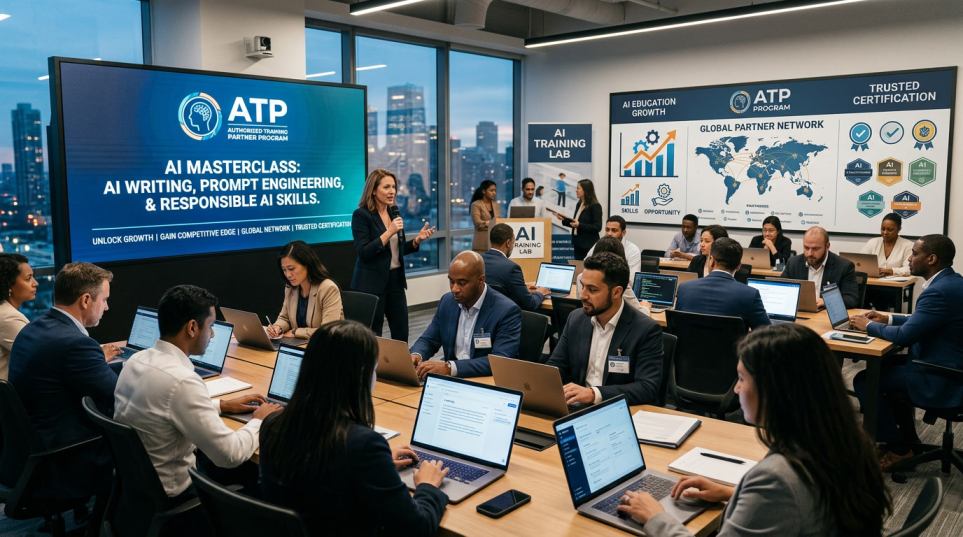
If your organization is ready to build this business the smart way, explore the AI CERTs Authorized Training Partner (ATP) Program and apply to become a partner today.
Frequently Asked Questions
1. What exactly does the new AI writing study prove?
It shows that readers rated AI-written short stories as higher quality and more engaging than human-written ones, and most readers could not reliably tell the two apart, even when trying.
2. Does this mean human writers are no longer needed?
No. Researchers were clear that this does not make human authors obsolete. It means editing, verification, and responsible AI use are now essential professional skills, which is exactly what structured training teaches.
3. Why should a training company choose the ATP model instead of building its own AI course?
Building a full curriculum from scratch takes time, money, and constant updates as AI tools change. The ATP model gives partners ready-made courses, trainer support, and a trusted global brand instantly.
4. Is this opportunity only for tech companies?
No. Universities, corporate training firms, associations, and even individual consultants can become a partner and offer AI training programs suited to their audience.
5. How do I start the process to become a partner?
Visit the official AI CERTs Authorized Training Partner (ATP) Program page to review the requirements and apply to join the global network.